
In the realm of bronze animal statues, the horse is unquestionably one of the most vibrant and vital subjects. However, each distinct posture of a horse statue articulates a unique spirit and narrative. Below, we recommend five iconic bronze horse sculpture poses tailored to specific project types — from the equestrian statue gracing a civic plaza to the standing horse anchoring a hotel forecourt — designed to facilitate a precise match and help you identify the ideal solution for your requirements.
5 Iconic Horse Poses for 5 Project Scenarios
It is well known that horse sculptures come in a diverse array of poses and horse sculpture styles, each carrying its own symbolic meaning and suited to specific outdoor environments.
1. The Full Gallop
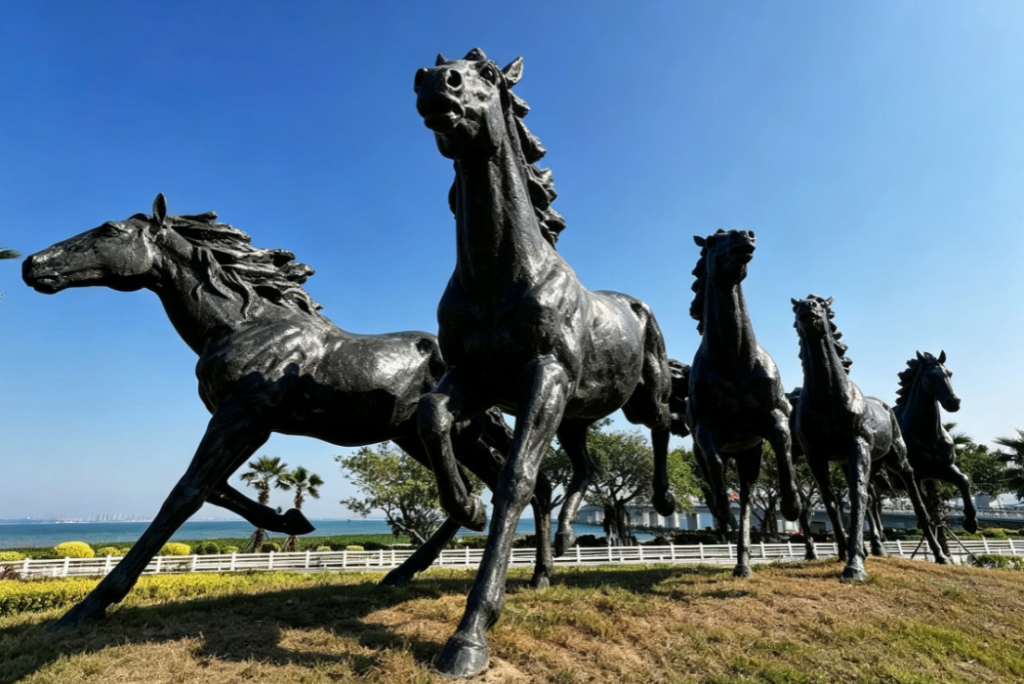
Exuding immense vitality and a powerful sense of movement, this galloping horse pose captures the striking visual of four hooves airborne with a flowing mane and tail. It is highly suitable for major transportation hubs and highway interchanges, serving as a prestigious “gateway landmark” and commanding focal point that defines a city’s first impression. To the passing eye, a running horse frozen mid-stride reads as pure momentum.
2. The Proud Stand
Characterized by a steady and composed stature, standing horse statues are majestic and solemn, projecting grace and power alongside a strong sense of conviction and dignity. Consequently, this is the ideal choice for judicial courts and government institutions. It is also a definitive selection for a corporate headquarters.
3. The Graceful Stroll
Depicting a horse moving with an alternating, calm cadence, this pose reflects elegance and leisure, imparting a high-end, noble sophistication with a timeless beauty that never dates. It is frequently utilized in luxury commercial districts and the grand entrances of five-star hotels.
4. The Rearing Stance
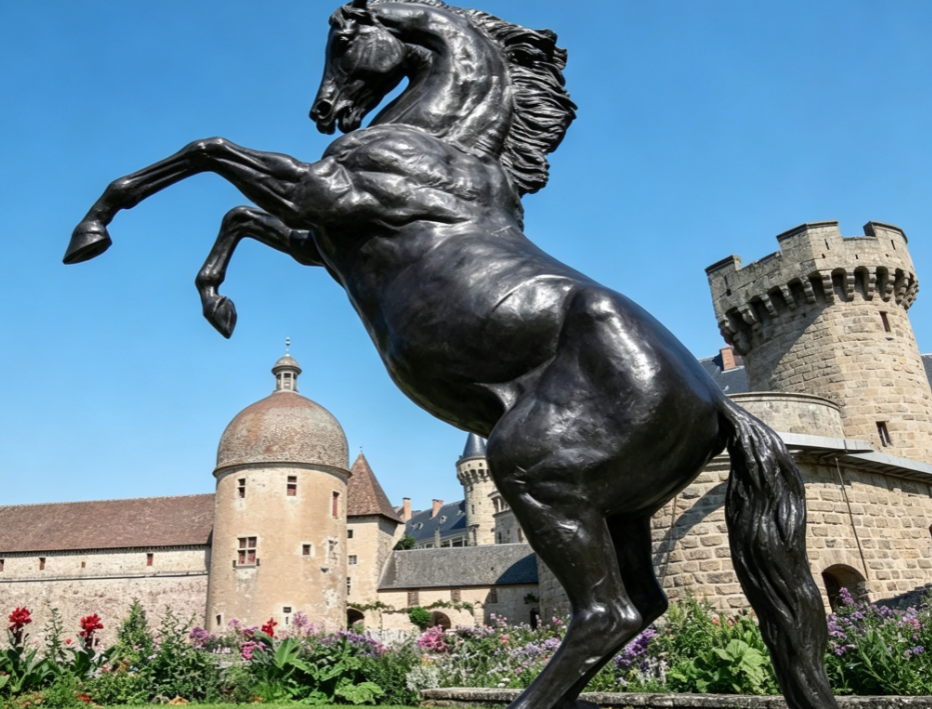
This rearing horse pose possesses a strong competitive aura, with front legs raised and the center of gravity shifted upward, radiating constant explosive power. A bronze rearing horse is virtually tailor-made for sports stadiums, horse racing venues, athletic arenas, or elite equestrian clubs.
5. The Gentle Bow
A head-down, implicit posture — often rendered as a bronze grazing horse — that is gentle and docile in nature. It naturally evokes a sense of intimacy and approachability, making it perfect for park lawns, children’s playgrounds, residential communities, and quiet outdoor garden settings.
Beyond these five classic forms, custom horse sculptures extend to abstract horse sculptures, the winged horse (Pegasus) of myth, the refined bronze arabian horse, and even the armored war horse of monumental history — ensuring every project can capture the spirit of the horse in its own visual language.
The Standing Horse: Dimensional Guidelines for Hotel Entrances
Luxury hospitality properties favor the standing horse statue for its commanding aura and powerful presence as an outdoor decoration at the property threshold. To achieve optimal visual balance, a standard dimensional formula is often applied: a 1:0.4 ratio between the hotel entrance width and the height of the sculpture. In practice, these metrics are meticulously calibrated to align with the specific architectural style and spatial nuances of each property.
Galloping & Rearing: The Engineering Balance of Three-Hoof Airborne Poses
In horse statuary, a pose with “three hooves airborne” delivers the highest visual tension but represents the greatest engineering challenge. Due to the high and concentrated center of gravity, rearing horse sculptures and dynamic galloping works demand exceptional structural integrity. Consequently, the technical difficulty regarding bronze material selection, fabrication, and welding is effectively doubled.
The counterweighting of the internal steel armature is paramount. Support is typically concentrated where the rear legs interface with the pedestal — the primary contact point — while the raised front legs carry no load at all. Because a horse’s hoof has a remarkably small surface area, the base must be reinforced with thickened steel plates or heavy cast iron to prevent forward tipping. To maintain absolute equilibrium, counterweight cavities — integrated with weighted concrete — are utilized at diagonal positions within the pedestal to balance the torque.
As a result, the cost of a bronze rearing horse sculpture in these dynamic poses is notably higher. Beyond the reinforced base, the custom forging of counterweights, increased material consumption, and sophisticated welding protocols significantly compound the complexity. When engineered correctly, it is a masterpiece of art; without precision, it becomes a structural liability.
Equestrian Statues: The Proportional Dynamics of Rider and Steed
Equestrian statues are a staple of government monuments and urban plazas, uniting horse and rider in a single heroic composition. Historically, the most famous bronze example is the bronze equestrian Statue of Marcus Aurelius from Ancient Rome, a gilded masterpiece standing approximately 4.24 meters tall. Regarding the proportional relationship within an equestrian sculpture, artists traditionally employ stylistic exaggeration: the rider’s torso is scaled larger than true human dimensions, while the warhorse is rendered relatively compact. This intentional technique is designed to emphasize the rider’s stature and commanding presence. Later works, such as the Equestrian Statue of Gattamelata, also adhered to this established proportional canon.
Size & Weight Reference Guide: Strategic Logistics Planning for Procurement
Four-Tier Scale Specifications & Container Requirements
Logistics strategies and container selections are meticulously determined by the specific horse statue dimensions and total mass of each bronze horse sculpture. The weight chart below spans four tiers — from tabletop pieces to the life size horse statue and beyond to monumental horse commissions.
1. Small-Scale Works (60–90 cm) With an approximate weight of 150 kg, these pieces — including compact figures and the popular bronze horse head — do not require a dedicated shipping container. Equally at home in indoor and outdoor settings, they are typically secured in professional wooden crates and dispatched directly via international express courier services.
2. Mid-Scale Works (1.2–1.8 m) Weighing approximately 500 kg, we recommend utilizing a 20GP (General Purpose) container. To prevent impact damage during transit, internal welded bracing is required to rigidly secure the sculpture within the container.
3. Large-Scale Works (2.0–2.4 m) With a mass of approximately 1,500 kg, a life-size bronze horse in this tier requires a 40GP container. Should the sculpture’s height exceed the 2.2 m interior clearance of a standard container, the piece is typically positioned horizontally or deconstructed into cast sections for reassembly at the destination.
4. Monumental Works (3.0 m+) For an oversized large horse statue exceeding 3,000 kg, specialized equipment such as 40OT (Open Top) or 40FR (Flat Rack) containers is mandatory. These large sculptures require crane-assisted top-loading, with the sculpture’s base welded and reinforced to the container structure for absolute stability.
Non-Standard Customization: Solutions for Specific Spatial Proportions
When standard dimensions cannot fulfill project goals or when precise architectural integration is required, a custom bronze horse built to a bespoke size is the optimal choice. The workflow begins with a detailed consultation to define the client’s specific requirements. Subsequently, Wensculp delivers a comprehensive design proposal including complimentary 3D renderings. Following this, a 1:10 scale clay maquette is produced for formal review to ensure all proportions and details align with the vision. The process culminates in the final confirmation and commencement of production — the same disciplined path we apply to custom horse statues and broader custom animal sculptures alike.
Comparative Analysis: Bronze vs. Stainless Steel Horse Sculptures
Bronze Horse Statuary: Classical Patina and 30-Year Durability
Whether a bronze horse statue commands attention depends primarily on two core pillars: the lost-wax investment casting process and the bronze patina technique. Lost-wax casting is the gold standard in bronze fabrication. The process begins by injecting molten wax into a silicone mold to produce a precise wax pattern. A robust refractory ceramic shell is then constructed around this pattern. Subsequently, the wax is evacuated from the shell — hence “lost-wax” — leaving a precise negative cavity into which molten bronze is poured. Patina, achieved through specialized chemical thermal coloring, is the final touch that truly breathes “soul” into every piece of cast bronze.
We offer a curated palette of finishes to suit every project identity:
- Classic Verdigris: A timeless museum staple with an authentic antique bronze character.
- Deep Brown: The most versatile and enduringly popular choice.
- Minimalist Black: A favorite for contemporary art galleries.
- Luxury Gold: Typically reserved for elite private clubs and estates.
- Polished Finish: A rare and distinctive contemporary option.
Stainless Steel Horses: Mirror-Finish Integration with Modern Architecture
Currently, the stainless steel horse is emerging as a premier metal horse sculpture choice, offering distinct strategic advantages over traditional bronze. Regarding material selection, Grade 304 and Grade 316 are both industry benchmarks. Grade 304 provides reliable corrosion resistance and high cost-effectiveness, making it a staple for urban plazas and commercial districts. In contrast, Grade 316 offers superior salt-mist resistance — specifically designed for outdoor coastal exposure — making it the essential specification for seaside commercial complexes and luxury maritime hotels built for demanding outdoor use.
From a technical perspective, mirror polish is the most widely utilized finish, capable of elevating surface reflectivity to over 90%. This high-gloss surface reflects the surrounding environment, creating a powerful visual expansion effect that broadens the field of view and imparts a sense of openness to confined spaces. This effectively illustrates why modern commercial architecture increasingly prioritizes stainless steel for its avant-garde aesthetic and spatial versatility.
Lost-Wax Investment Casting: Full Production Transparency Across 33 Distinct Stages
Precision lost wax casting is a sophisticated manufacturing protocol that creates a high-fidelity negative cavity by evacuating a wax pattern, enabling the casting of intricate metal forms. Characterized by its immense technical complexity, a single equine sculpture must undergo a rigorous sequence of 33 distinct stages. As a bronze horse manufacturer with decades of foundry craftsmanship, Wensculp upholds absolute operational transparency; from the initial clay maquette to the final masterpiece, every phase of the journey is open to client oversight.
The Clay Maquette: Rigorous Equine Anatomical Research
The clay model horse serves as the definitive first step in translating a design from paper to physical reality. The ultimate vitality of an equine sculpture is determined during this critical phase, as it is here that the contours of the musculature, the tension of the tendons, and the orientation of the coat are established. A seasoned sculptor possesses an intuitive mastery of equine textures — understanding the exact direction, depth, and density of the hair — to ensure every detail is lifelike and strictly adheres to the physiological traits of the specific breed.
Hand-Chasing and Patination: Defining the Final 20% Quality Distinction
Once the raw casting of a high-quality bronze horse is complete, standard foundries may often conclude the process with basic grinding and polishing. A premier foundry, however, goes much further, executing meticulous hand chasing and chemical bronze patina work at a near-millimeter level of precision. This represents the most critical phase of the fabrication cycle, bridging the final 20% quality gap that separates a common casting from a high-art masterpiece. It is this unwavering attention to detail that determines the ultimate character, prestige, and market value of every crafted horse.
Commercial Projects: A 90-Day Cycle from Design to Delivery
Efficiency is the cornerstone of successful project execution. For a standard-scale outdoor horse commission — whether a commercial sculpture for a plaza, a landmark for mixed-use outdoor spaces, or a signature hotel installation — a premier foundry can manage the entire lifecycle, from initial design to final installation, within a 90-day window.
3D Scene Rendering and Architectural Integration
A professional foundry operates in direct collaboration with architects, providing complimentary 3d rendering services. By utilizing the architect’s CAD data, we can accurately simulate light and shadow effects and provide multi-angle site-context visualizations of the proposed hotel horse within its future surroundings. This empowers stakeholders to make intuitive decisions and request technical adjustments before physical fabrication commences.
The 90-Day Milestone Schedule: Design to Dispatch
A 90-day lead time is a definitive benchmark of manufacturing maturity. While a standard technical breakdown — Design Confirmation (2 weeks), Clay Maquette (4 weeks), Casting (6–8 weeks), Surface Finishing (2 weeks), and Logistics (1 week) — may technically exceed 100 days, an optimized production timeline allows a mature foundry to compress the cycle to within 90 days, with the shipping schedule locked in well before dispatch. Professionalism is defined by maintaining uncompromising quality standards even within an accelerated production timeline.
Related Reading: 6 Key Decisions for Choosing Bronze Lion Statues for Your Entrance | Collection: Bronze Animal Statues | The Lost-Wax Casting Method