
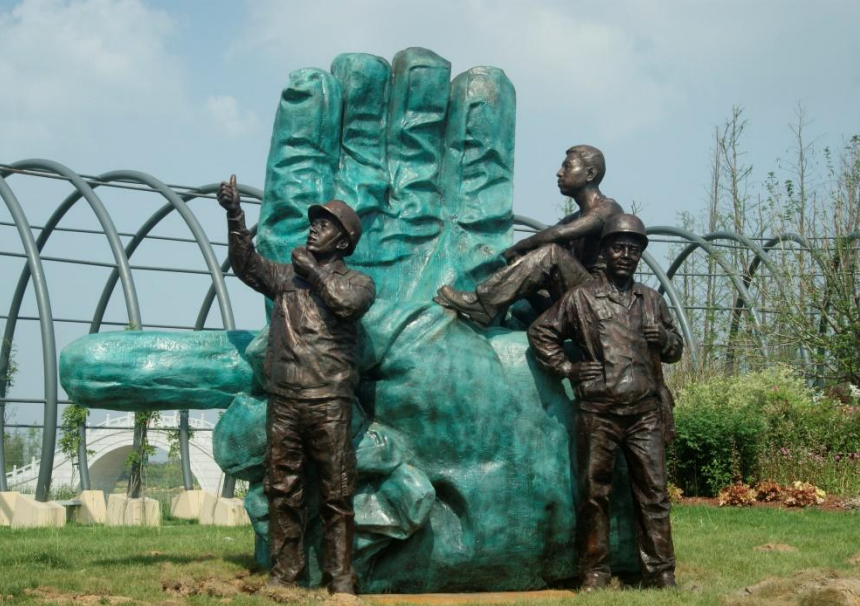
The sculpture The Glove was produced using the lost-wax casting process — one of the oldest and most precise methods of bronze casting known to humanity. In this process, a wax pattern is created, and the melted wax leaves behind a negative space that is subsequently filled with molten bronze. Lost-wax bronze casting has been practiced since the Bronze Age, with origins traced to the 3rd millennium BC in Mesopotamia. The technique later flourished in Ancient Greece and spread through Greek and Roman civilizations, establishing a legacy spanning over two millennia. This process remains the industry standard for high-precision fabrication of bronze statuary, representing a technical heritage of over 2,500 years.
Step-by-Step: The Precision Lost-Wax Casting Process
Think of the lost-wax casting process as “first making a wax model, then burning it away to leave a cavity that is filled with metal”; the resulting metal part will replicate the details of the wax model as closely as possible.
Step 1 — Clay Modeling by Master Sculptors
Before Professor Sun Shaoqun (Hubei Institute of Fine Arts) began modeling The Glove, a robust internal armature was welded from steel pipes to establish the core structural framework. A clay core was first packed around the armature to define the internal volume, after which specialized oil-based clay was applied over the surface. The original sculpture was meticulously built to full scale over a 30-day lead time.
Step 2 — Rubber Mold Production
Three layers of professional-grade silicone were applied in sections to the clay surface, maintaining a desired thickness of 8–10mm. Unlike polyurethane rubber, silicone captures finer surface detail and releases more cleanly from complex forms. This was then encased in a rigid mother mold reinforced with fiberglass and resin. Once fully cured, the sectional molds were disassembled batch-by-batch according to their specific serial numbers.
Step 3 — Hollow Wax Casting
Molten wax was poured into the sectional silicone molds and continuously rotated to ensure uniform coverage. As the wax casting cooled against the mold surface, it solidified into a hollow wax model with a precise wall thickness of approximately 0.5mm. Any air bubbles trapped during pouring were identified and filled at this stage, before the piece advanced to chasing.
Step 4 — Wax Chasing & Detail Refinement
Artisans utilized thermal tools to eliminate parting lines and refine every nuance of the figures and the glove’s texture. This stage is also referred to as metal-chasing in its bronze equivalent — here performed first in wax to establish the definitive surface before casting. The precision of this wax chasing phase is critical, as it determines the ultimate aesthetic definition of the final bronze piece.
Step 5 — Ceramic Shell Application
Each wax module was repeatedly dipped in refractory slurry — a mixture of colloidal silica and refractory powder — and coated with varying grades of sand for 8–12 layers. This building process ensures the ceramic shell possesses the necessary thermal stability and structural strength for the pour.
Step 6 — Burnout Kiln & Wax Removal
The completed shells were placed in a high-temperature furnace. Applying heat hardens the ceramic shell while the wax melts and runs out through the spruing channels. Wax rods — part of the spruing system — are attached to channel molten metal and allow air to escape during the pour. The melted wax can be collected and reused for future castings. This critical stage represents the namesake “lost-wax” element of the process.
Step 7 — Bronze Pour at 1,200°C
A premium alloy of copper, tin, and lead was smelted in a crucible in a furnace to 1,200°C. The metal is poured continuously into the preheated ceramic shells, perfectly occupying the negative space left by the original wax pattern. The filled shells are then set aside undisturbed until the bronze has cooled and fully solidified.
Step 8 — Shell Breakout & Surface Chasing
Once solidified, the mold is broken away by hammer to reveal the rough casting. The surfaces were then cleaned via pressurized sandblasting to remove all refractory residues and expose any imperfections for repair. The bronze is then reheated locally where needed, allowing artisans to work the metal surface and refine texture in a process that mirrors the earlier wax chasing stage.
Step 9 — Sectional Welding & Assembly
The individual sections were precisely aligned and welded together through high-precision welding, with overall tolerances maintained within ±1.5mm. This was followed by intensive grinding and polishing to achieve a seamless surface finish.
Step 10 — Chemical Thermal Patination & Sealing
In the final artistic phase, Chemical Thermal Patination was applied using reagents like ammonium chloride and copper sulfate, replicating the oxidized surface character found on bronzes from antiquity. The process involved 5 spray cycles and 3 heat cycles, followed by a composite protective seal of microcrystalline wax and acrylic resin for long-term durability.
What Is Bronze Made Of? The 88% Copper Alloy
Bronze sculptures utilize a specialized alloy of copper, tin, and lead. This specific metallurgical formulation is engineered to optimize melt fluidity, structural hardness, and casting adaptability, making it the premier choice for complex sculptural molding.
The Rationale Behind the Ratio
High copper concentrations significantly enhance the sculpture’s corrosion resistance. However, the strategic inclusion of tin and lead is critical to achieving the necessary fluidity and hardness for precision casting. For The Glove, this specific ratio was the most effective solution — ensuring the molten alloy could seamlessly penetrate every intricate detail of the mold while maintaining the rigorous structural integrity required for the piece.
Tailored Formulations, Not Rigid Standards
The application of “88% Copper” for The Glove was a bespoke response to the client’s high-quality specifications and Wensculp’s extensive foundry expertise. We do not adhere to a single rigid standard; instead, we dynamically calibrate alloy ratios based on the sculpture’s scale, the intended installation environment, and the specific fabrication techniques involved. While 88% represents a high-tier benchmark, our material science is always tailored to the unique requirements of each project.
Achieving Patina & Antique Bronze Finishes
Bronze patination is generally categorized into two methodologies: cold and hot processes. For The Glove, we implemented Chemical Thermal Patination (hot process) to ensure maximum color stability and molecular-level bonding. In contrast, cold patination involves ambient-temperature chemical treatments, commonly utilized to achieve traditional bronze or verdigris (green rust) effects.
Antiquing & Textural Depth
To evoke a sense of historical gravitas in The Glove — reminiscent of bronzes recovered from antiquity — we intensified the pigmentation within recessed grooves and shadows. This technique accentuates the sculpture’s volumetric depth and creates an authentic oxidized texture. Advanced finishing options — including the integration of mineral aggregates, selective highlights, and sophisticated tonal gradients — are also available to precisely define the artwork’s visual focal points. Our curated color palette — encompassing deep bronze, umber, obsidian, and various shades of teal and verdigris — is achieved through proprietary chemical formulations and meticulous application via precision spraying or hand-brushing.
Protective Encapsulation
To guarantee the long-term environmental resilience of The Glove in outdoor settings, we apply a high-performance protective seal. Utilizing specialized lacquers, microcrystalline waxes, or industrial-grade clear coats, we establish a robust barrier that effectively mitigates oxidation and UV-induced fading, preserving the sculpture’s aesthetic integrity for decades.
5 Reasons Lost-Wax Casting Produces Superior Bronze Sculpture
The bronze sculpture The Glove, fabricated through the precision lost-wax process, demonstrates five critical advantages that distinguish it from standard castings:
1. High-Fidelity Detail Replication
The versatility of wax as a medium allows for effortless engraving and meticulous refinement. For The Glove, this facilitates the high-definition rendering of intricate leather textures, the fluid movement of garment drapery, biological skin grains, and nuanced facial expressions.
2. Unconstrained Geometric Freedom
Precision lost-wax casting eliminates the barriers to geometric complexity. It empowers artists to explore limitless creative possibilities, facilitating the realization of complex curvatures, intricate openwork, sharp directional transitions, and bold asymmetrical forms without technical compromise.
3. Mastery of Complex Internal Structures
The lost-wax process is uniquely capable of managing hollow cores, thin-wall sections, deep undercuts, and intricate internal cavities. Concepts that are often deemed unmanufacturable by traditional methods are successfully brought to life through this advanced engineering protocol.
4. Optimized Surface Finish & Reduced Post-Processing
Castings produced via this method feature superior, near-net-shape surface finishes and crisp ornamental definition. This significantly minimizes the need for aggressive post-cast grinding and labor-intensive chasing, preserving the purity of the original artistic vision.
5. Superior Dimensional Accuracy
Utilizing high-precision wax patterns ensures exceptional dimensional stability. In large-scale sectional casting, this results in minimal assembly discrepancies and ensures that the final proportions of the monument adhere to the strictest engineering tolerances.
The Engineering Logic Behind Monumental Bronze Sculptures
The design of monumental bronze statuary transcends simple sketching. It requires a holistic engineering approach that integrates thematic vision, spatial scale, environmental context, and structural mechanics into a unified strategy. This foundational phase ensures that the subsequent modeling and casting protocols are precisely aligned with the project’s requirements.
Strategic Sectional Casting for Oversized Installations
The monumental sculpture The Glove utilizes a precision sectional design strategy. By deconstructing the figure into specialized components—including the head, torso, limbs, and individual fingers—we optimize the fabrication workflow for high-fidelity casting and facilitate seamless structural assembly.
Internal Steel Armature & Structural Engineering
Bronze sculptures transcend mere artistic form; they must be engineered for long-term structural integrity and environmental resilience. To ensure the installation remains stable and permanent, we integrate robust internal steel armatures. Beyond freestanding sculpture, this engineering approach also applies to large-scale relief panels, where wall thickness and internal support must be precisely calculated for permanent installation. This engineering-led approach stabilizes the center of gravity and guarantees that the work can withstand extreme lateral forces, such as high-velocity typhoon winds.
Site Installation Planning & Anchoring
On-site, we utilize 3D total stations or laser scanning to perform real-time coordinate calibration between the component prisms and the design blueprints. This ensures the seamless, high-precision alignment of dozens of sectional modules in the air. Foundations are treated as critical civil engineering structures; we typically employ reinforced concrete foundations paired with independent steel sub-frames to strictly comply with regulatory codes for soil bearing capacity, wind load resistance, and seismic performance.
Real Size Reference: 3.2m to 17.5m Projects We’ve Completed

Wensculp’s proven track record of monumental fabrications includes the 3.2m cast bronze sculpture The Glove and the landmark 17.5m Welcome Gate at Huangshi National Mine Park, masterfully executed using a combination of forged copper and natural stone.
Related Reading: Clay Model | Forging and Casting | Sculpture Surface Finishing | Transportation and Installation