Sculpture Casting and Forging Services
Mastering both traditional and contemporary metalworking, we provide high-standard bronze casting and artisanal hand-forging services for enterprises.
Bronze Casting: The Lost-Wax Process
Lost-wax casting—also known as investment casting—is a high-precision fabrication method. It is specifically engineered for metal objects with intricate three-dimensional geometries that surpass the capabilities of traditional molding techniques.
Basic Principles
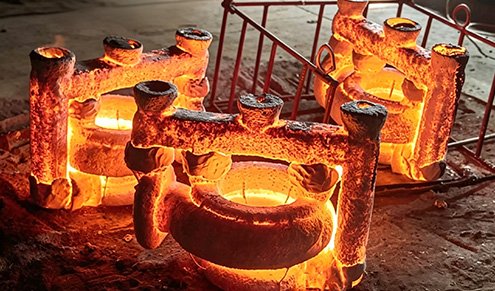
A wax pattern is first sculpted from beeswax or specialized wax compounds to represent the final form. This pattern is then encased in multiple layers of refractory materials—such as silica sand or ceramic clay—to create a robust mold. Through heat treatment, the wax is melted and evacuated (dewaxing), leaving a precise negative cavity into which molten metal is poured. Once the metal has cooled and solidified, the outer shell is removed (knockout), revealing a high-fidelity metal casting that perfectly replicates the intricate details of the original wax pattern.
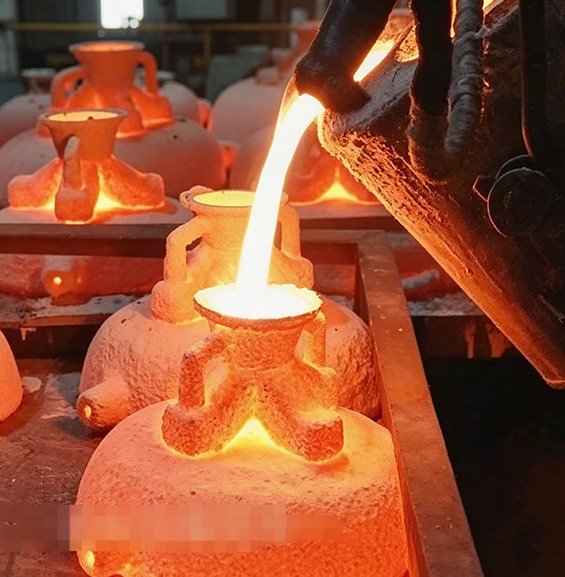
The Lost-Wax Casting Process
1:1 Full-Scale Clay Modeling
Our master sculptors meticulously craft the original clay pattern at a full 1:1 scale, ensuring every detail aligns strictly with the project’s design specifications.
Silicone Mold Fabrication
We apply three precision layers of medical-grade silicone to the master pattern, reinforced with multiple layers of high-strength fiberglass cloth. During the curing process, the mother mold thickness is strictly maintained between 8–10mm to ensure maximum dimensional stability and tear resistance.
Wax Pattern Creation & Meticulous Refinement
Utilizing pressure injection with 62°C microcrystalline wax ensures the high-fidelity replication of intricate details and thin-wall sections as fine as 0.5mm. Skilled artisans then perform manual thermal retouching to eliminate seams and refine every surface transition to perfection.
Ceramic Shell Investment & Stuccoing
We execute five repeated cycles of slurry coating and stuccoing, each followed by controlled air-drying to build 8–12 layers of refractory material. The shell is reinforced with high-grade mullite sand to ensure exceptional thermal stability and structural resistance during the casting process.
Dewaxing & High-Temperature Burnout
The investment shells undergo constant-temperature drying at 48°C for 7 days until a shell thickness of 15mm is achieved. A rigorous 900°C burnout process is then applied for 12 hours to eliminate all internal wax residues and vitrify the ceramic mold, preparing it for molten metal.
Induction Melting & Precision Casting
Utilizing medium-frequency induction furnaces, we melt high-purity electrolytic copper alloys at precisely controlled temperatures between 1150°C and 1200°C. For monumental castings, we implement continuous pouring protocols to ensure a monolithic structure and eliminate the risk of cold shuts or structural seams.
Knockout & Shot Blasting
After the initial shell removal (knockout), the raw castings undergo rigorous sandblasting. This is followed by 4 hours of continuous shot blasting using 0.4mm steel shot to ensure a perfectly clean surface and optimal texture for subsequent finishing.
Precision Assembly & Structural Reinforcement
We utilize 3D total stations for high-precision alignment and assembly. Every monument is reinforced with an internal 304 stainless steel armature, maintaining assembly tolerances within ±1.5mm. This structural engineering guarantees the stability required to withstand Category 10 winds.
Chemical Thermal Patination
Utilizing professional-grade chemical reagents, we execute a rigorous finishing protocol involving 5 spray cycles and 3 heat cycles. The coloring is achieved through a controlled temperature gradient rising from 150°C to 300°C, ensuring a stable, multi-layered, and artistic finish.
Materials for the lost-wax casting process
Primary Material: High-purity Silicon Bronze or Tin Bronze with a guaranteed 88% copper content, engineered to meet the most stringent museum-grade standards for durability and aesthetic depth.
Other Metals: Our fabrication expertise extends to Brass, Stainless Steel (Grade 304/316), and ornamental applications of Precious Metals (Gold & Silver Gilding).
Hand-Forged Sculptures: Stainless Steel and Red Copper
Basic Principles
Hand-forged metal sculptures are artisanal masterpieces crafted from high-quality metal sheets. Utilizing traditional manual techniques such as precision hammering, forging, and seamless joining, these sculptures are typically fabricated using premium red copper or stainless steel plates as the primary medium.
The Process of Forged Sculpture Production
Digital Modeling & Prototyping
We directly interface with your CAD/BIM design manuscripts, utilizing high-precision 3D Prototyping to create scale models. This ensures 100% Accuracy (zero-deviation replication) during the subsequent full-scale lofting process.
Lofting & Material Cutting
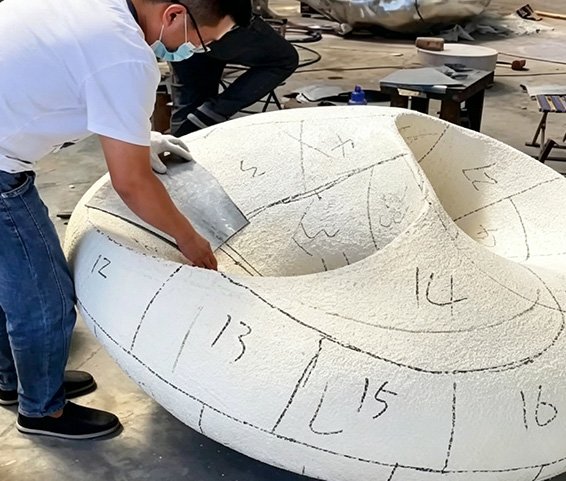
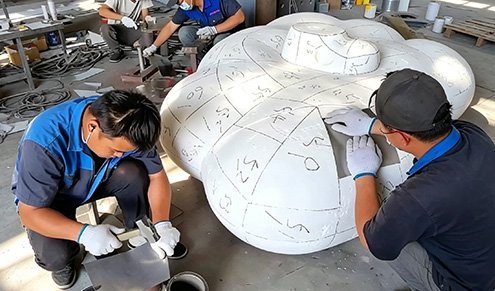
The design blueprints are meticulously transferred onto templates to create dozens of full-scale (1:1) modules. These modules serve as the precise guide for tracing outlines onto copper plates, ensuring high-fidelity material blanking for each sculptural component.
Artisanal Hammering & Shaping
Guided by the precise geometry of the templates, our master artisans manually hammer the reverse side of the metal plates (repoussé technique). This meticulous process ensures the metal perfectly conforms to the complex contours of each sculptural module.
Precision Welding & Structural Reinforcement
Individual forged components—such as the head, limbs, and ornamental details—are seamlessly integrated through high-precision welding to form a unified whole. For monumental outdoor pieces, we incorporate a pre-calculated 304 stainless steel armature to guarantee absolute structural stability and safety in public spaces.
Advanced Surface Finishing
Following the assembly, the sculpture undergoes professional mirror polishing or chemical thermal patination. As a final stage, a protective layer of microcrystalline wax or a high-performance clear coat is applied to stabilize the color and provide a robust barrier against environmental degradation and atmospheric corrosion.
Applications of Forging and Casting
Ideal Application Scenarios for Hand-Forged Sculptures
Abstract Sculptures: Ideal for geometric abstraction and kinetic sculptures. These pieces leverage the unique tensile strength of forged metal to create fluid, dynamic forms.
Large-Scale Landscape Sculptures: Perfect for stainless steel urban landmarks and public plaza installations. Forged structures offer superior structural integrity and high-impact visual presence for monumental urban projects.
Reliefs: Including hand-forged copper reliefs and bespoke artistic wall ornamentation. These are widely utilized in interior and exterior facade designs to add cultural depth and texture.
Robust & Expressive Styles: Specializing in historically-inspired weapons, armor, and avant-garde contemporary art. The hammering marks of the forging process highlight a raw, powerful aesthetic.
Ideal Application Scenarios for Cast Sculptures
Figurative Statuary: Ideal for religious icons (Buddhist deities), historical figures, and commemorative monuments. Casting allows for the high-fidelity capture of facial expressions and anatomical nuances.
Intricate Geometries: Perfect for architectural ornamentation and openwork (hollow-out) installations. The lost-wax process excels at realizing complex, multi-dimensional forms that are impossible to achieve via traditional molding.
Monumental Installations: Suited for public art commissions and large-scale commercial reproductions. Casting ensures structural uniformity and a prestigious, substantial presence for large urban artworks.
Serialized Production & Replication: Supporting commercial sculpture editions and high-end souvenirs. Once the master mold is created, casting facilitates the efficient replication of multiple units with absolute consistency in quality.
Materials Suitable for Forging and Casting
- Forged: 304 stainless steel, red copper, brass
- Cast: 62# brass, bronze (copper-tin alloy), aluminum, zinc
How to Choose Between Forging and Casting
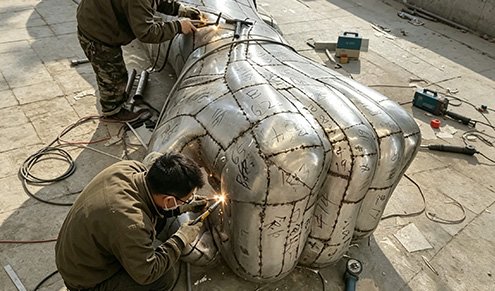
We recommend selecting "Artisanal Hand-Forging" if your project requires:
Modern Aesthetics: Ideal for abstract art, showcasing fluid metallic lines and a sophisticated sense of geometric facets.
Monumental Scale: With no dimensional restrictions and a superior strength-to-weight ratio, it is the premier choice for massive urban landmarks.
Extreme Durability: Offers exceptional structural integrity and environmental resilience, engineered to withstand even the harshest outdoor conditions.
Artisanal Texture: Perfect for those seeking the unique, organic hammer-mark textures inherent in master hand-forged craftsmanship.
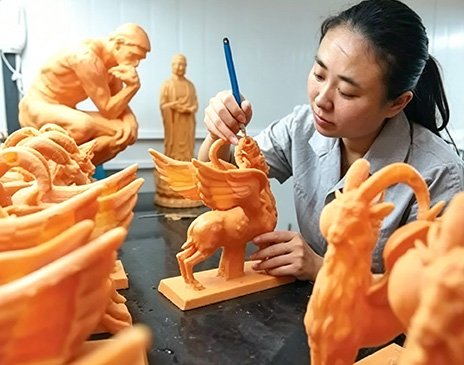
We recommend selecting "Precision Investment Casting" if your project requires:
Extreme Detail & High-Fidelity Replication: Necessary for capturing intricate nuances, such as subtle facial expressions, fine fur textures, and the delicate movement of drapery.
Classical Realism & Artistic Essence: The premier choice for traditional styles where preserving the “Artistic Spirit” is paramount, ensuring a 99% likeness between the final bronze and the original clay model.
Exceptional Geometric Complexity: Ideal for designs featuring multi-dimensional or complex three-dimensional structures that surpass the capabilities of other fabrication methods.
Serialized Production & Scalable Consistency: Engineered to support limited-edition series or batch replication, guaranteeing that multiple units maintain absolute consistency in scale, detail, and quality.