Hankou served as the critical land-water transshipment hub for the Great Tea Road. During the late Qing Dynasty, tea from across China converged at the Hankou wharves. Local porters would shoulder heavy tea chests, transporting them to the concession warehouses and docks before they were exported across land and sea to Russia and Europe. Through this vibrant trade, Hankou earned its prestigious title as the “Oriental Tea Port,” solidifying its position as the premier gateway of the Great Tea Road.
Anatomical & Figurative Realism:
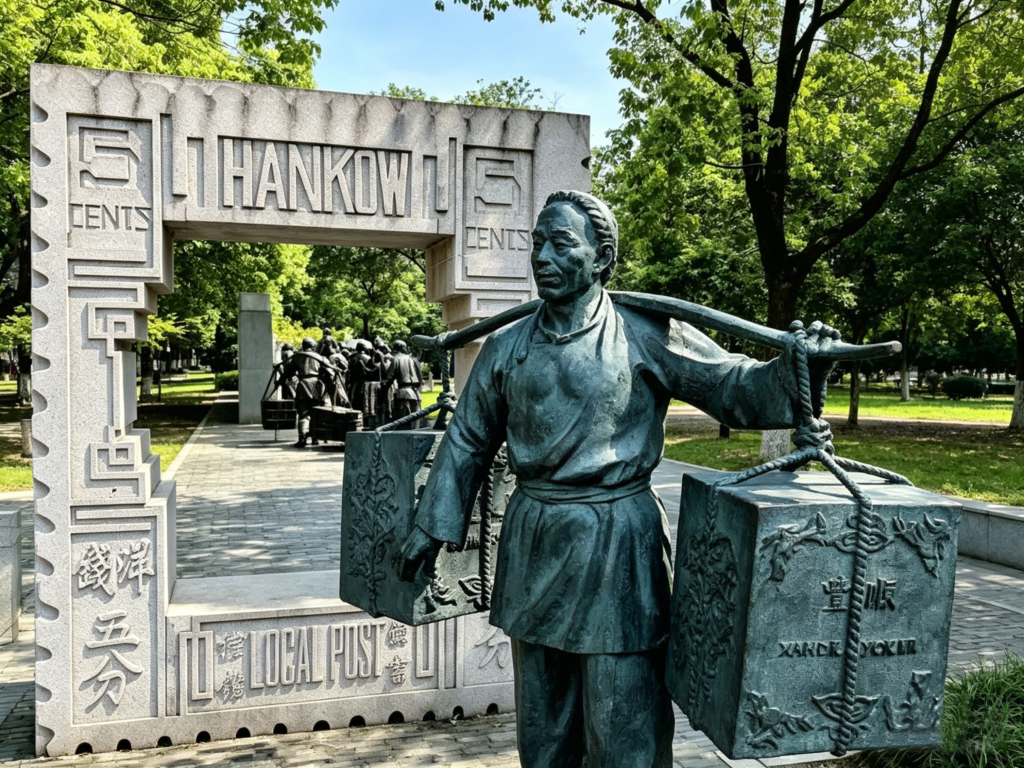
The laborers are rendered in authentic late-Qing attire, featuring defined, sinuous musculature and a grounded, stable physique. Depicted with shoulder poles (bian dan) horizontally braced and hands steadying the ropes, their resolute yet weathered facial expressions provide a hyper-realistic portrayal of the arduous labor characteristic of the historic docks.
Period-Accurate Material Detailing:
The tea chests are meticulously engraved with the historic “XANDE YOCKER”commercial insignia. The chest surfaces feature high-relief carvings of interlocking floral patterns (Chanzhi), a precise historical reconstruction of the packaging used by local Hankou tea merchants at the turn of the century.
The “Stamp” Stone Archway:
The background stone pailou (archway) replicates the iconic Hankou “Five-Cent” local post stamp. It is engraved with historical markers: “HANKOW,” “LOCAL POST,” “CENTS” alongside Chinese characters for “Five Cents” and merchant names “Defu” and “Yufeng”. This installation serves as a powerful philatelic and postal symbol of the late Qing Hankou Concessions, signifying the seamless flow of tea along international trade and postal routes.
Spatial Composition & Visual Depth:
The arrangement utilizes a progressive spatial composition, with a team of porters extending deep into the walkway. This creates a sense of theatrical depth, effectively recreating the historic spectacle of hundreds of tea workers moving in synchronized labor, providing an immersive experience for the viewer.
Material Specifications & Manufacturing Protocols
Material Specifications
Figurative Elements & Tea Chests: Fabricated from high-purity Cast Tin Bronze. The surface features an artisanal verdigris patina achieved through specialized alkaline etching. This finish is specifically engineered for high-humidity riparian environments, providing exceptional resistance to oxidation, intense UV exposure, and heavy precipitation along the riverfront.
Stamp-Motif Archway: Constructed from Premium White Sesame Granite. Prized for its density and extreme weathering resistance, the stone is intricately carved with varying line depths to faithfully replicate the historical stamp perforations and typographic textures.
Manufacturing Protocols
Bronze Components: Executed via Precision Lost-Wax Investment Casting. For these monumental figures, we utilize an integrated sectional casting strategy to ensure structural uniformity and the high-fidelity capture of historical details.
Stone Architecture: A hybrid fabrication approach combining Artisanal Hand-Carved Relief with high-precision CNC Engraving. This ensures the precise reconstruction of the original Hankou “Local Post” stamp layout, including the intricate serrated edges and the sophisticated Chinese-English seal script.