
Bronze lion statues have long stood as a timeless symbol of power and protection. As the king of beasts, the lion is the ultimate representation of strength — a symbol of strength guarding gates from imperial palaces to modern corporate campuses. Choosing a bespoke pair of bronze lion sculptures for an entrance involves six key decisions: style, posture, size, color, specifications, and installation. This ultimate guide covers each in order, based on our 50 years of experience and hundreds of delivered bronze animal sculpture projects.
nety percent of reworks in entrance lion projects stem from failing to define two critical factors before placing an order: the proportional scale relative to the entrance width and the foundation anchoring specifications. While aesthetic styles can be refined at leisure, these two technical parameters must be locked in first.

Yi Mingzhi, CEO of Wensculp
Quick Selection Chart
| Architecture/Scenes | Recommended Lion Type | Recommended Pose | Common Patina |
|---|---|---|---|
| Palaces, temples, Chinese-style gardens | Chinese Guardian Lions (Pair) | Seated Lion | Green / Brown |
| Banks, universities, European-style villas | European Realistic Lions | Seated Lion / Standing Lion | Brown / Black |
| Modern hotels, city squares, art spaces | Modern Abstract Lions | Standing Lion / Roaring Lion | Black / Multicolor Gradient |
| Sales offices, large shopping malls | Realistic Dynamic Lions | Pouncing Lion (Attacking Pose) | Brown / Gold |
Matching Style to Architecture: Chinese, European, or Modern
Assess the architecture first, then select the lion. Match Chinese architecture with Traditional Guardian Lions; European, financial, or academic structures with European Realistic Lions; and modern glass-curtain-wall buildings with Abstract Minimalist Lions. Style mismatch is the most common cause of failure in entrance projects, whatever type of lion sculpture you ultimately choose.
Traditional Chinese Guardian Lions:
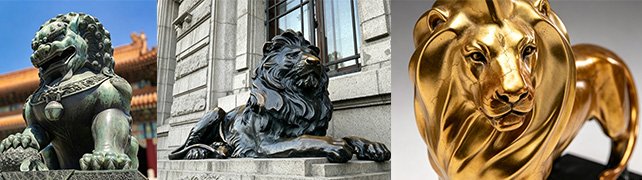
Majestic and strictly paired, the traditional lion of China carries deep symbolism in every detail. Orientation is determined from the perspective of standing inside the entrance looking out: The Male (Left) rests its right paw on a brocade ball (its symbolic meaning: power); the Female (Right) cradles a cub with its left paw (symbolizing lineage prosperity). Both must face outward — this is the defining convention of the Chinese lion.
European Realistic Lions :
Rooted in heraldic traditions, symbolizing courage and royalty — a lineage that also produced the crowned lion statue and the bronze winged lion of St. Mark in Venice. Upright sitting realistic lions are a century-old paradigm for financial institutions (the famous bronze HSBC lions are the most notable example). Lions with an extended right paw are frequently used as university mascots. Sitting or reclining realistic lions are ideal for elevating the prestige of European villas and high-end commercial districts.
Modern Abstract Lions :
Lion forms are abstracted through geometric lines while preserving the proud silhouette and sense of power — a bold statement designed to command attention. These pair exceptionally well with glass curtain walls and exposed concrete. Commonly specified for contemporary hotels, plazas, and art galleries.
Selecting Pose by Aura: Sitting, Standing, Roaring, or Pouncing
While style defines the aesthetic, pose determines the emotional resonance. These four postures are ranked here from the most stable to the most dominant:
- The Sitting Lion:
The quintessential guardian posture. Placed symmetrically at main entrances, the bronze sitting lion is the standard specification — and the perennial popular choice — for financial institutions, private estates, and traditional Chinese architecture. - The Standing Lion:
Features all four legs grounded with the head held high. Offering more momentum than the sitting pose, it is ideal for long driveway entrances and sites requiring high-level visibility from a distance — the top choice among lion statues for driveway approaches. - The Roaring Lion:
Characterized by an open mouth and flared mane, the bronze roaring lion is the most expressive of the four. A roaring lion statue is suitable for public plazas and commercial spaces requiring a bold visual presence. - The Pouncing Lion:
Depicted with front limbs airborne, rear legs driving, and mane bristling. Delivering maximum explosive power and visual impact, this pose is highly favored for commercial real estate, specifically at premium sales centers and shopping mall entrances. Beyond these four, quieter forms — the lying lion statue, the sleeping lion, or the walking lion — trade dominance for approachability, making them well suited to garden paths and courtyard settings.
Proportional Scaling: The 0.3–0.4 Golden Ratio
The total height of the sculpture (including the pedestal) should be approximately 0.3 to 0.4 times the entrance width. This ratio is a proven industry benchmark derived from our extensive project portfolio; improper scaling results in either a diminished presence or an obstructed visual field. For symmetrical pairings, the optimal clearance between the sculpture and the door frame edge is typically 1/5 to 1/4 of the entrance width—an empirical standard established through Wensculp’s on-site installation expertise.
The same ratio applies at residential scale. For a home entrance, a luxury estate gate, or the front of house of a private villa, correctly scaled lion statues for home settings enhance curb appeal rather than overwhelm the facade — the most common mistake we correct in property entrance projects.
Patina Selection: 5 Mainstream Finishing Options
Patina (Chemical Thermal Patination) is a dense oxide layer formed by the reaction of specialized reagents with the bronze at high temperatures. This finish is molecularly integrated with the bronze substrate — it is not a coating and will not peel or flake, which is what makes outdoor bronze lion statues genuinely weather resistant. For outdoor installations, we recommend an annual waxing to maintain long-term color longevity. Our five primary selections include:
Classic Brown: Versatile and timeless. This is the primary specification for corporate entrances, hotel lobbies, and industrial parks.
Verdigris (Green): Offers the strongest classical aesthetic. It pairs perfectly with traditional Chinese gardens, heritage architecture, and museums.
Minimalist Black: Sophisticated and understated, with a quiet elegance. Ideal for contemporary art galleries, high-end private estates, and boutique art spaces.
Gold (Gilded Aesthetic): Luxurious and prestigious — the definitive majestic bronze finish. Best suited for luxury retail and elite private clubs. This process requires precise calibration of reagent concentrations and regional temperature gradients to highlight the intricate texture of the mane; it demands the highest level of craftsmanship from our master colorists.
Multi-tone Gradients: Featuring transitions between two or more hues (e.g., brown-to-gold or black-to-gold). This provides the richest visual depth and is typically reserved for signature landmark projects.
Technical & Material Specifications: Three Critical Contractual Benchmarks
When evaluating suppliers of high-end bronze sculptures, insist that these three verifiable metrics be defined within your contract: Casting Process, Copper Content, and Wall Thickness. Wensculp’s standards are as follows:
Lost-Wax Investment Casting :
Making bronze lions to museum standard follows this workflow: Clay Prototype → Silicone Molding → Wax Chasing → Ceramic Shelling → Casting → Grinding & Welding → Chemical Patination.
Technical Note: During the wax phase, our sculptors perform manual wax chasing on every individual piece to refine mane textures, facial details, and muscular definition. We ensure that the molding process never compromises artistic precision or anatomical accuracy.
Material Grade: 88% Copper Content :
We utilize premium cast bronze with a guaranteed 88% copper content. This alloy is engineered for superior corrosion resistance and UV stability — the durability benchmark that makes it the optimal medium for permanent outdoor display. It is the material foundation of every high-quality bronze lion we deliver.
Graded Wall Thickness :
Thickness is strictly controlled and graded according to the sculpture’s scale.
Customers who need to customize the theme, dimensions, and color scheme based on their venue can review the Custom Sculpture Design.
What is the maximum scale achievable for your bronze lion sculptures?
Our standard customization capabilities span from 0.5m to 5 meters in height. A large bronze lion exceeding 2 meters is classified as a large-scale engineering project, necessitating integrated internal steel armatures and specialized foundation anchoring schemes. For dimensions surpassing monolithic casting limits, we employ a modular sectional casting strategy followed by professional on-site welding and assembly. Once our meticulous grinding and patination processes are complete, all joints are rendered invisible, ensuring a flawless, monolithic finish.
What level of precision can be achieved through lost-wax investment casting?
The lost-wax process is engineered for absolute detail preservation. It captures the finest nuances of the original clay prototype, from individual strands of the mane to intricate anatomical musculature, producing a truly lifelike result. Critically, our artisans perform manual wax chasing on every individual pattern prior to shelling; in professional foundry practice, molding and hand-craftsmanship are complementary, not mutually exclusive. The final result achieves maximum design fidelity, remaining virtually identical to the original model. The most effective way for a buyer to verify this precision is to request side-by-side comparison photography of the wax pattern and the finished bronze casting.
Comparative Analysis: Selecting the Optimal Medium for Your Guardian Lions
| Dimensions | Bronze Lion | Stone Lion | Fiberglass Lion |
|---|---|---|---|
| Advantages | Produced using the lost-wax casting method, these pieces feature a rich texture and lifelike appearance. | Easy to maintain, long-lasting, | Lightweight, Quick, and Inexpensive |
| Disadvantages | They are costly to produce, require a long production cycle, and demand a high level of craftsmanship from the manufacturer. | The corners of the sculptures are prone to weathering and chipping; due to the limitations of the stone, the details are relatively generalized. | Tends to feel lightweight; ages and fades under UV light; has a short lifespan |
| Suitable Scenarios | Storefronts, plazas, hotels, religious and commemorative projects | Traditional gate lion scenes characterized by “stability, solemnity, and durability” in Chinese architecture, mausoleums, and traditional settings | Short-term exhibitions and projects with limited budgets |
In summary: Select bronze to establish a lasting legacy and premium prestige; choose natural stone for authentic traditional Chinese contexts; and specify fiberglass (FRP) for short-term or budget-driven requirements. Wensculp specializes in all three mediums and can provide a comparative proposal tailored to your project budget.
What is the typical lead time from order to installation, and how do you handle shipping damage?
Production Lead Time: The traditional fabrication cycle for bronze sculptures typically spans several months. The exact lead time is contingent upon the sculpture’s scale, technical complexity, the number of sectional divisions, and the specific surface finishing requirements. For a standard pair of entrance lions of moderate size and complexity, the typical turnaround is approximately 90–120 days — a timeline worth confirming in writing before buying bronze lion statues from any foundry.
Shipping Damage & Claims: We provide comprehensive protection against transit-related risks. We require an unboxing inspection immediately upon receipt; please capture photographic and video documentation of any discrepancies. Based on this evidence, Wensculp will facilitate either professional on-site restoration or priority re-fabrication of the sculpture to ensure your project remains on track.
Frequently Asked Questions (FAQ)
How do I determine the correct left/right orientation for Chinese Guardian Lions?
Placement is determined from the perspective of standing inside the entrance looking out: The Male (resting its paw on a ball) is positioned on the left, and the Female (cradling a cub) is on the right. Both sculptures must be oriented facing outward to guard the entrance.
How long will the Patina finish last in an outdoor environment?
Our chemical thermal patination is molecularly integrated with the bronze substrate; it is not a coating and will not peel or flake. With basic annual cleaning and waxing, outdoor lion statues remain exceptionally stable and will naturally develop a deeper, more prestigious antique character over the years.
What is the recommended spacing for a symmetrical pair of lions?
For optimal visual balance and “presence,” the clearance between the sculpture and the edge of the door frame should be approximately 1/5 to 1/4 of the total entrance width.
Do you provide technical drawings and installation support?
Absolutely. We provide a comprehensive technical package, including foundation structural drawings, bolt-positioning templates, and detailed English installation manuals. For monumental projects, our engineering team offers remote technical guidance to ensure a flawless and secure setup.
Related Reading: 5 Horse Poses by Project Type | Collection: Bronze Animal Statues | The Lost-Wax Casting Method