
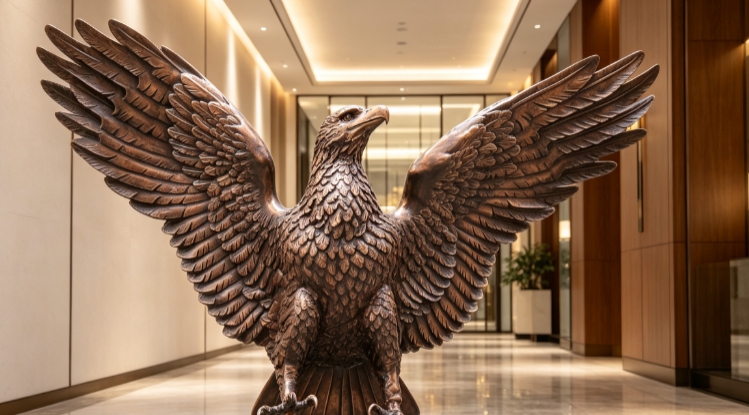
The most common question first-time buyers ask about a custom bronze animal statue is simple: if I only have a photo, a sketch, or a reference image, how do you turn it into a life-size bronze that looks exactly the way I want? For buyers who have never worked with an overseas foundry, the real worry is losing control somewhere between “the idea” and “the crate that arrives.” Using our Eagle bronze sculpture for Palm Springs Hotel in Wuhan as a real example, this guide walks through how the process actually works — and where you, the buyer, get to check and approve before anything is cast.
What You Can Start With
You don’t need a finished design to begin. In practice, most custom animal statue projects start from one of these:
- A photograph — a real animal, an existing statue you like, or an image from a catalog
- A 2D drawing or sketch — even a hand drawing is enough to establish pose and proportion
- A 3D file — if your designer or architect has already modeled it (STL, OBJ, etc.)
- A written brief plus references — for example, for our Eagle: what pose do you want — wings spread, or taking off — and where will it go, such as a hotel garden?
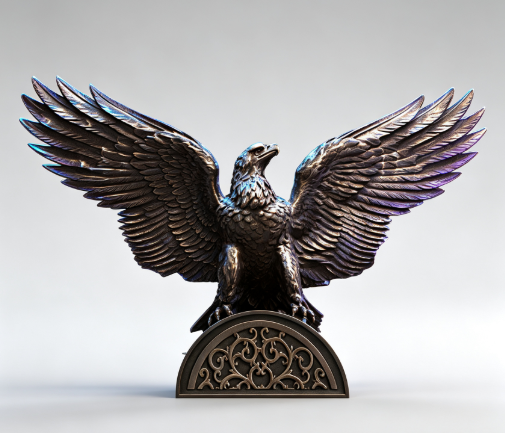
The more you provide on pose, proportion, and the exact species, the closer the first model will be. Species reference matters most — an eagle with wings fully spread reads very differently in bronze depending on the reference, and a generic “eagle” image leaves a lot open to interpretation.
Step 1 — Design & 3D Modeling
The Eagle reference is first translated into a digital 3D model (some workshops also start with a small-scale clay maquette). This stage locks in the overall proportion, pose, and silhouette before any expensive work begins. You receive renderings to review. This is the cheapest point in the whole project to make changes, so it’s worth being specific here — angle of the head, position of the wings, whether the bird is static or mid-motion.
Step 2 — The 1:1 Clay Model (or 3D Print)
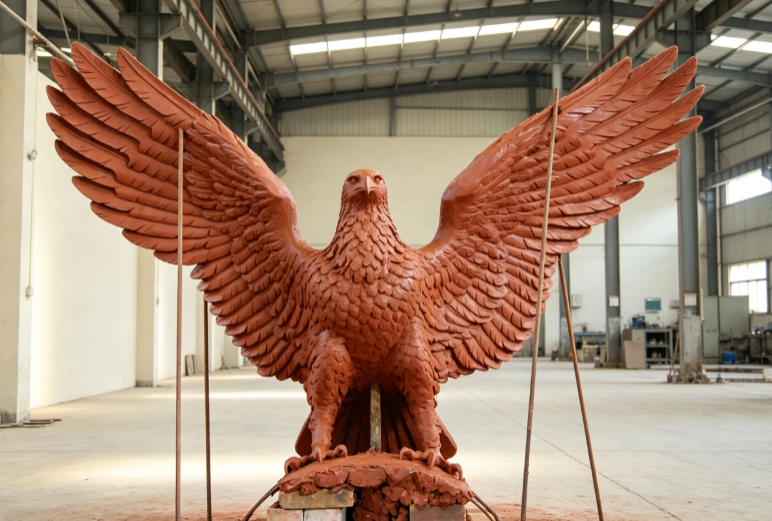
For our Eagle at Palm Springs Hotel, a full-scale model was prepared before casting. This is the single most important checkpoint in the whole process, because the model is what the bronze will copy exactly — muscle flow, feather texture, and the bird’s expression are all resolved here. Where the detail requirements allow, a 3D print can be used at this stage to keep costs down.
You confirm the model through photos and video. If any detail needs adjusting, we refine it at this stage — and we keep refining until the model matches exactly what you want. Only then do we move to the next step. Nothing is cast without your confirmation. This is what protects a first-time overseas buyer: you’re not paying for a finished bronze and hoping it matches — you sign off on the exact form first, and we follow a documented production process throughout.
Step 3 — Casting
Once the Eagle model is approved, it goes to casting. Bronze animal statues are produced by lost-wax casting, which faithfully reproduces fine surface detail; larger, simpler forms can also use sand casting. Large Bronze animal statues are cast in sections and joined, with welds ground and chased until the seams are essentially invisible.
Step 4 — Patina, Finishing & Sign-off
The raw Eagle casting is then patinated (chemically colored) and finished to the agreed color and texture. For an animal sculpture like the Eagle, this stage carries much of the realism — here, a warm brown patina. You review finishing photos before it is packed.
Step 5 — Packing, Shipping & Installation Support
The finished Eagle is crated in a timber box and sent to the client. For overseas clients, we ship by air or sea freight, send photos for your confirmation before dispatch, and prepare all documentation required for international shipping.
For large-scale sculptures, Wensculp sends technicians for on-site installation. For smaller pieces or works that require simple assembly, we provide installation drawings and remote guidance — and before production begins, we share the foundation/anchoring technical drawings with you in advance, so the piece won’t arrive unable to be installed properly.
How Long Does It Take?
Lead time depends on size, complexity, and whether the piece is fully custom or based on an existing model. As a rough guide to production time (final schedule confirmed per project):
- Under 2 m — around 3 weeks
- 2–4 m — around 4–5 weeks
- Large group sculptures — around 6–8 weeks
These are approximate production cycles only; the final timeline is set according to the specific sculpture, and can also be adjusted to the client’s required delivery date.