
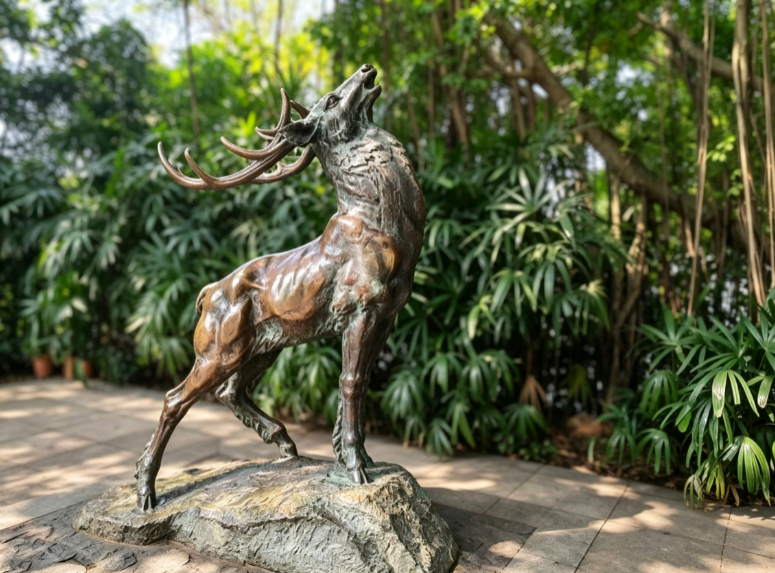
Size is the one decision buyers get wrong most often — and the mistakes are the most expensive to fix. A bronze that looks perfect in a photo can feel too small on an open plaza, or overwhelming in a courtyard. Choosing the right size isn’t only about “how big is my budget.” Take the Deer Call bronze stag in Guangzhou’s Luhu Park: what matters is where in the park it sits, how far away people view it from, and what stands next to it. This article gives you practical principles for matching size to placement.
1. Start by Defining the Sculpture’s Role
| Setting | Common recommended height | Effect it creates |
|---|---|---|
| Indoors, courtyards, private gardens | 0.5–1.5 m | Intimate, refined, meant for close viewing |
| Villa entrances, hotel entrances, commercial landscaping | 1.2–2.5 m | Presence without overpowering the architecture |
| Parks, campuses, farms, resorts | 1.8–3.5 m | At or slightly above life-size — a visual focal point |
| City plazas, landmark entrances, memorial projects | 3–10 m and up | Recognizable from a distance; iconic and monumental |
These ranges are only a starting reference. The exact size should be driven by the surrounding environment and building density, foot traffic, and the area of the site. As a rule of thumb, cities often treat under 3 m, 3–10 m, and over 10 m as the small, medium, and large scale bands for bronze animal sculpture.
Work From Viewing Distance, Not From the Sculpture Itself
● Close viewing: 0.5–5 m
Best for indoor pieces, courtyards, small garden scenes, and sculptures beside a walkway.
Recommended size: roughly 0.5–1.5 m tall.
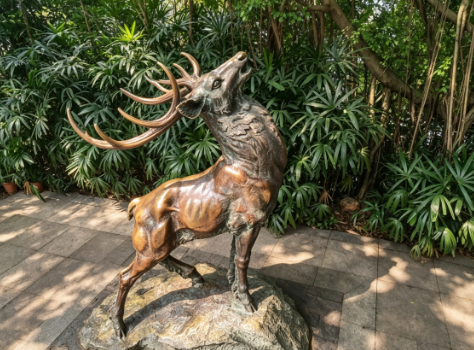
These are usually realistic in style, emphasizing the animal’s muscle, fur, and detail. If you add a base, it typically accounts for only a quarter to a third of the sculpture’s height, depending on the animal’s pose. The Deer Call bronze stag in Guangzhou’s Luhu Park, for example, stands on a natural rock base: the figure itself (the deer, excluding the stone) is about 1.8 m tall (from hoof to the tip of the antlers), and the total height including the natural rock base is about 2.4–2.6 m.
● Mid-range viewing: 5–15 m
Best for hotel entrances, courtyard centers, landscape axes, and commercial-property entrances.
Recommended size: roughly 1.2–3 m tall.
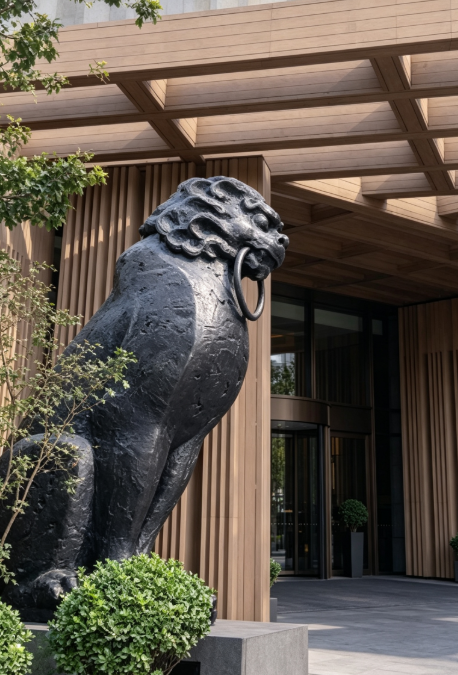
The subject can be more varied here, and you should check the effect from the entrance, the driveway, the main windows, and the seating areas. At the main entrance of Rosewood Beijing (the auspicious beast from the “Nine Sons of the Dragon”), a 2.8 m piece (excluding the low stone base) — the Jiaotu, a traditional guardian beast, finished in an antiqued bronze patina — sits on both sides of the drop-off drive so guests see it the moment they step out of the car. It’s a classic case of Eastern luxury-hotel entrance bronze.
● Long-range viewing: 15–50 m and beyond
Best for parks, city plazas, campuses, road entrances, and large landscapes.
Recommended size: usually 2.5 m and up, reaching 5–10 m or more when needed.
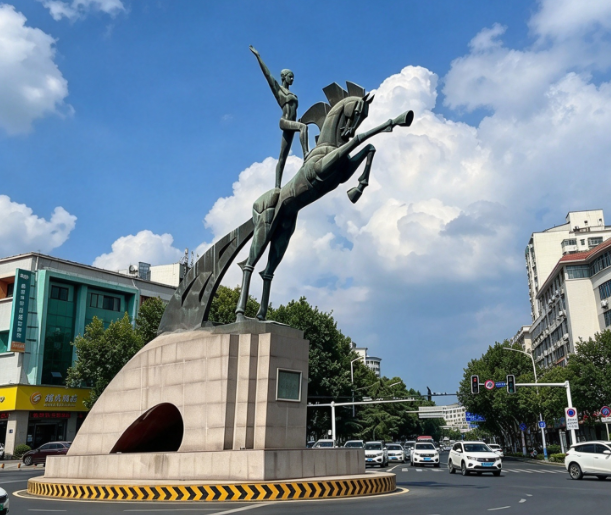
Prioritize the overall silhouette, posture, and recognizability. Long-range projects must also account for nighttime lighting, background color, and seasonal foliage that may block the view. Urban-sculpture research often uses the relationship between viewing angle and viewing distance to judge scale: a longer viewing distance generally calls for greater mass, and when an open space is too large, a small piece easily looks out of proportion. One example stands 13 m tall and 12 m long and weighs 7 tons — a knight and rearing horse leaping into the air, set on the lawn of a central city plaza as the core landscape sculpture. It’s a classic large bronze horse over 10 m: a single-point display for an open courtyard or plaza, with a powerful sense of force.
Sizing by Placement — Practical Ranges
Different settings call for different mass. As a rough direction (always confirm the final size against your actual site):
Private garden / courtyard — life-size or slightly smaller usually works; the deer reads like a detail you “discover.”
Hotel lobby / interior — sized to the ceiling height and sightlines; oversized pieces easily feel jarring indoors.
Residential / commercial landscaping — life-size to slightly larger, so it holds its ground among planting and buildings.
Public plaza / civic space / park entrance — usually needs oversized scale to command the open space and long viewing distances.
Roundabout / landmark position — needs monument-level mass, readable to passing vehicles and from a distance.
Adjust the Proportions by Animal Type
Different animals have different builds, so you can’t judge size by height alone.
1. Horses, cattle, deer, antelope
A near-life-size horse usually occupies more visual and structural space than a bear or lion of the same height. Well suited to large entrances, ranches, hotels, racecourses, and wide lawns.
2. Lions, bears, tigers
These animals carry strong mass, so even a smaller size creates clear presence.
Entrances or courtyards: consider 1.0–1.8 m.
Large landscapes: consider 2–4 m.
For low or reclining poses, double-check the width and viewing angle.
3. Elephants, rhinos, hippos
The animals are large by nature, so focus on ground load, rigging, and foundation rather than height alone.
Small decorative versions can be 0.8–1.5 m.
Near-life-size pieces usually need a larger site.
4. Birds, giraffes, snakes
These often have pronounced vertical or horizontal extension.
Birds’ wings and tail feathers easily add to the overall width.
A giraffe’s height may exceed a comfortable proportion against surrounding low-rise buildings.
Low animals like snakes and lizards should gain length and a curving posture so they remain recognizable from a distance.
Leave Enough Room Around It
A sculpture isn’t an object in isolation — it needs “breathing space.”
Some starting principles:
Keep about 0.9–1.2 m of clear passage on the main sides.
Leave at least about 0.6 m on secondary sides, clear of door leaves, fire exits, and equipment-service areas.
Ideally keep visual blank space around the piece close to its largest dimension.
For a group, consider each piece’s size, the spacing between animals, and the overall composition together.
For example, a 3 m tall, 4 m long group of running deer can’t be given just 4 m² of ground. You also have to account for viewing distance, people walking around it, plant growth, lighting equipment, and maintenance-vehicle access.
Confirm the Size With an On-Site Mock-Up
Before you cut the mold or place the order, do a scale check on site:
Drop a 3D image of the sculpture into the scene, or shoot the environment first, mark the height with a measured marker, then place the sculpture into the image based on the footage and check from different angles whether the size fits.
Simulate the sculpture body and base together.
Observe from the vehicle entrance, the building entrance, the main walkways, the seating areas, and the far viewpoint.
Check it under daylight, dusk, and nighttime lighting conditions.
See whether trees, shrubs, and the building backdrop obscure the animal’s silhouette.
Don’t Forget the Base
The base of the Deer Call bronze stag in Guangzhou’s Luhu Park adds height and changes how the sculpture reads. A life-size deer on a tall base becomes a landmark; Deer Call set at ground level among planting reads as naturalistic. If the sculpture is 2 m and the base is 0.6 m, the installed total height is 2.6 m. For a hotel entrance or gate area, it’s that 2.6 m — not the 2 m sculpture alone — that actually drives the visual proportion. Decide on the effect you want — intimate and realistic, or elevated and monumental — because it shapes both the sculpture’s size and the base material you commission.
How to Confirm the Size Before Ordering
Provide your site dimensions and photos — the space determines the size.
Ask for a scale reference during the design/rendering stage (place a human silhouette next to the sculpture for comparison).
Confirm the final height including the base, not just the animal figure itself.
Related Reading: Bronze Animal Statue Cost Guide | Custom Statue from Your Photo | The Lost-Wax Casting Process