

You’ve found a Chinese foundry whose work you like. The real question comes after casting: how does a 950 kg bronze statue from China travel safely to your site — and who makes sure it arrives undamaged and stands securely for decades? Using a real project as proof, this guide explains exactly how an experienced foundry ships and installs a bronze animal statue overseas, so that before you order you know who is responsible for each stage and what you need to prepare.
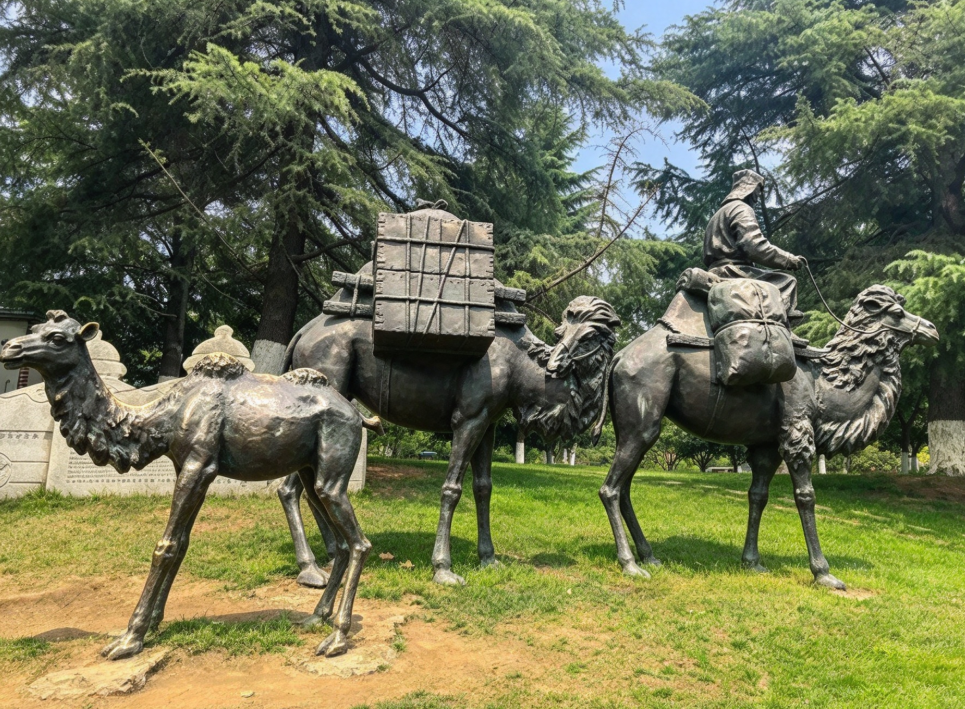
Real Case | Wanli Tea Road Camel Caravan, Hankou Riverfront
Location: Wanli Tea Road Cultural Park, Lanling Gate area, Hankou Riverfront, Wuhan
Material: tin-bronze cast, antique brown patina
Design: three Bactrian (double-humped) camels, recreating a northbound Qing-dynasty tea caravan on the Wanli Tea Road
Structure: cast in sections (three camels)
Project Specs
| Item | Detail |
|---|---|
| Dimensions | Group 10.5 m long × up to 2.4 m high |
| Weight | 955 kg (cast in sections, assembled on site) |
| Transport | 42 km by road (Huangpi workshop, Wuhan → Hankou Riverfront) |
| Anchoring | 10× M40 anchor bolts on an embedded steel-plate base, distributing the load |
| Wind resistance | Level 11 gale load (checked against Wuhan’s 50-year basic wind pressure of 0.40 kN/m², open riverfront site) |
| Inspection | Monthly visual check (riverfront: focus on salt-spray corrosion) / annual structural, weld and bolt check / third-party assessment every 5 years |
This 955 kg camel caravan was a domestic project, but the sectional casting, heavy lifting, anchoring against wind, and on-site assembly it required are exactly the capabilities needed to export a large bronze overseas. Every step below uses it as the example.
First Thing: Know “Who Is Responsible for Which Stage” (Incoterms)
For an importing buyer, this is the single most important thing to confirm before ordering. Shipping responsibility is divided by Incoterms; three are common:
- FOB — the foundry delivers the statue onto the ship at a Chinese port; you arrange the sea freight, insurance, customs clearance, inland transport and installation. Lowest unit price, but you handle the back half.
- CIF — the foundry also covers sea freight and insurance to the destination port; you handle clearance and everything after.
- DDP — the foundry delivers to your specified location, covering almost everything. Most hassle-free for you, highest unit price.
A foundry that can quote FOB, CIF and DDP alike has mature export experience. Always confirm the term in writing to avoid the “who handles this now?” situation at the port, which leads to high demurrage fees.
Key reminder: whichever term applies, the concrete foundation and embedded parts must be completed to the foundry’s drawings before the statue reaches the port — otherwise the statue arrives with nowhere to be installed.
Step 1 | Site Survey & Technical Assessment — Find the “Trouble Spots” Early
The foundry first establishes the statue’s true height, width, weight, base dimensions and center of gravity. Four-legged, long-necked, head-raised or outstretched designs often have a center of gravity off the geometric center, which determines where the slings must attach so it won’t tip. It also confirms whether the piece is hollow or sectional, and locates weak points such as ears, horns, legs and tails. For export projects, it also assesses the road height limits, turning radius and crane access from the destination port to the site, based on the information you provide.
Case | Camel Caravan: the group was cast in three sections, each with its center of gravity calculated separately. The camels’ slender legs are a weak point in transport and lifting, and were flagged for special protection at the survey stage.
What this means for you: the foundry maps out the risk points before work begins, so you won’t discover on arrival that the piece can’t fit or can’t be lifted.
Step 2 | Plan the Transport & Installation — Fix Every Move in Advance
With the plan locked, nothing has to be improvised on site. The foundry selects transport and lifting equipment by size and weight, and defines the lifting points, lashing positions and loading/unloading sequence; for large statues it runs lifting calculations to ensure the safe working load of slings, shackles, spreader beams and crane all exceed the actual weight. For export projects, this is also when sea-freight booking, out-of-gauge permits and insurance are arranged. Sectional manufacturing is a common solution for large statues: when a single piece is too big to transport, it is cast in sections and assembled on site.
Case | Camel Caravan: 955 kg in three sections, with the crane sized for the heaviest single piece plus a safety margin. The assembly order was set as “raise the main camel first, then join the second camel and the calf,” with seams designed in advance to fall in inconspicuous places.
What this means for you: the sectional approach lets even an oversized statue fit into a container or flat rack for sea freight, reducing both shipping difficulty and cost.
Step 3 | Condition Record & Export Crating — Clear Responsibility, No Load on Protruding Parts
Before dispatch, the foundry photographs the piece from front, back, side and top, recording existing scratches, welds and patina — so any later damage can be traced to whether it was pre-existing or occurred in transit, keeping responsibility clear. Protruding parts get their own wooden frames, cushioning is soft and acid-free, and nothing rubs directly against the surface. Export crates must be ISPM 15 fumigated and stamped with the IPPC mark, or destination-port customs will not release them. Support points sit on the solid base or internal reinforcement, never pressing on thin bronze panels or decorative detail.
Case | Camel Caravan: the camels’ legs, humps and other prominent parts were each given individual wooden frames; the three pieces were packed in separate custom export crates, all ISPM 15 fumigated.
What this means for you: compliant export crating is the prerequisite for smooth clearance and undamaged arrival — ask the foundry for the ISPM 15 treatment certificate.
Step 4 | Loading & Sea Freight — Keep Hollow Bronze From Being Shaken Apart
The transport stage guards against sliding, tipping and vibration. Lifting uses inspected equipment under a dedicated signaler; wire ropes never bind the surface directly, and padded slings avoid fragile parts. On the road, air-suspension vehicles are preferred to dampen vibration; at sea, the piece is firmly secured inside the container or flat rack to prevent shifting from the ship’s motion. Throughout, hard braking, sharp turns, prolonged sun exposure and rain are avoided.
Case | Camel Caravan: the 42 km city route used air-suspension flatbed trucks in batches, each piece fixed to a transport frame with no lateral movement. For an export project this stage extends to: factory container loading and securing → sea freight → destination port.
What this means for you: hollow bronze is most vulnerable to sustained vibration; proper securing and shock absorption ensures a bronze statue from China crosses thousands of kilometers of sea freight without cracking.
Step 5 | Foundation Work & On-Site Lifting — What Decides Whether It Stays Put and Upright for Decades
The result of this step is long-term stability, correct orientation and wind resistance. Before installation, confirm the concrete foundation’s strength, level, drainage and embedded anchor-bolt positions, and check that the base plate, holes and bolts all match — running a dry, glue-free, weld-free test fit if needed. Lift from the pre-set points, keep the piece balanced and lower it slowly into place, then adjust the centerline, orientation, level and viewing angle. Finally, fix it with anchor bolts, tightening to the specified torque; the base anchoring is designed to the local wind load, which is the key to wind resistance. Sectional statues are then assembled in order, with seams sealed and joints ground.
Case | Camel Caravan: on the open riverfront site, 10 M40 anchor bolts on an embedded steel plate distribute the load, with anchoring checked against a level 11 gale (basic wind pressure 0.40 kN/m²). The three pieces were assembled in order — main camel, second camel, calf — and the seams were ground and patinated to match the whole.
What this means for you: as long as the foundation and anchoring follow the drawings, the statue will stand securely in your local high-wind conditions.
Step 6 | Inspection, Repair & Acceptance — Confirm Every Risk Before Handover
The foundry or installer checks verticality, base contact and whether any anchor bolt is loose; and inspects welds, joint seams, connectors, drainage holes and the risk of internal water pooling. Minor scuffs from transport are repaired by professionals — never with ordinary paint or acidic cleaners. The surface is cleaned, and the patina, protective wax or coating confirmed intact. Post-installation panoramic and detail photos are taken, and the transport records, lifting records, material certificates and acceptance sheet are compiled, along with an inspection schedule. High salt-spray environments such as riverfronts and coastlines require close monitoring of surface corrosion.
Case | Camel Caravan: acceptance confirmed the three pieces were solidly assembled, the seams consistent and the drainage clear. Inspection was set as a monthly visual check (with a focus on riverfront salt-spray corrosion), an annual structural, weld and bolt check, and a third-party safety assessment every 5 years.
What this means for you: a complete set of acceptance records and an inspection schedule is the basis for the statue’s long-term maintenance and warranty.
Who Handles Installation Overseas?
This is the importing buyer’s biggest concern. There are usually two options:
- Option A | The foundry sends an engineer to supervise installation on site: suited to large, high-value or structurally complex projects, with a Chinese engineer overseeing the lifting and assembly.
- Option B | The foundry provides drawings + embedded parts + remote guidance: the foundry delivers detailed installation drawings and embedded parts, your local crane crew carries out the work, and the Chinese side gives video guidance throughout. Suited to smaller or budget-sensitive projects.
Either way, the concrete foundation and embedded parts are completed by you in advance, to the foundry’s drawings. Confirm before ordering which type of installation support the foundry can provide — it directly determines how smoothly things go on the ground.
What Determines the Cost of Shipping a Bronze Statue from China
- Weight and size — determine the grade of transport and lifting equipment
- Whether it’s sectional — sections add assembly cost but reduce transport difficulty and sea-freight cost
- Shipping method and distance — sea-freight mode, how far the destination port is
- Incoterms — DDP is the most hassle-free and most expensive; FOB is the cheapest but you handle the back half
- Lifting difficulty — oversized pieces, riverfront/coastal sites and restricted locations all add cost
- Foundation work — borne by you, and needs to be budgeted in advance
Shipping Cost & Transit Time (Reference)
Sea freight has no fixed price — it varies greatly with the route, season, peak/off-peak timing and the size of the statue. The ranges below are to help you build a budget; the actual figure is per your freight forwarder’s live quote.
By Shipping Method
| Method | Suitable for | Reference cost | Notes |
|---|---|---|---|
| LCL (consolidated) | Small statues, single piece ≤ 1–2 m | ~USD 80–200 / CBM | Charged by volume |
| 20GP full container | Medium or multiple pieces | ~USD 1,500–4,500 | Varies with route and season |
| 40HQ full container | Multiple/taller pieces | ~USD 2,500–6,500 | Large volume, good value |
| Flat rack | Over-width/over-height, won’t fit a standard container | Quote on booking | Common for large statues |
| Breakbulk | Oversized single pieces, multi-ton | Quote on booking | Used for large pieces like this caravan |
Note for large statues: a piece like this caravan — 2.4 m high and 955 kg — ships as breakbulk. Settle the shipping method with the foundry and forwarder together at the time of ordering.
Port-to-Port Transit Times by Region
| Destination region | Reference transit |
|---|---|
| Southeast Asia | ~7–15 days |
| Middle East (Dubai, etc.) | ~18–25 days |
| US West Coast (LA / Long Beach) | ~14–20 days |
| US East Coast (New York, etc.) | ~28–40 days |
| Europe (Rotterdam / Hamburg) | ~30–40 days |
| Australia (Sydney, etc.) | ~18–28 days |
These are typical port-to-port sea-freight times from major Chinese ports, excluding export packing, destination clearance and inland transport.
Full Timeline (Order to Installed)
Export packing 2–3 days → sea freight ~30 days (depending on destination port, including all customs procedures) → foundation completed in advance on site → lifting and installation 1–3 days. On-site assembly of large sectional groups takes longer, depending on the statue’s scale. We provide a full timeline for your bronze animal statue before production begins.
FAQ
Q1: Who arranges the international shipping — the foundry or me?
It depends on the Incoterms. Under FOB, you arrange the sea freight and everything after; under CIF, the foundry covers it to the destination port; under DDP, the foundry handles almost everything to your site.
Q2: What do I need to prepare before the statue arrives?
Complete the concrete foundation and embedded anchor bolts / steel plate in advance, to the foundry’s drawings, and be sure to finish before the statue reaches the port to avoid storage fees.
Q3: Who installs the statue in my country?
Either the foundry sends an engineer to supervise on site, or it provides drawings + embedded parts + remote guidance for your local crane crew to carry out — both are open to discussion.
Q4: How is a large or multi-piece bronze statue shipped and installed?
Large statues or groups are cast in sections and shipped as separate pieces, then lifted onto the pre-set anchor bolts on site and assembled.
Q5: Can it withstand strong wind after installation?
Yes. The base anchoring is designed to the local wind load — for example, this caravan is checked against a level 11 gale.
Q6: How do you protect the bronze surface during sea freight?
Protruding parts get individual wooden frames, acid-free cushioning, ISPM 15 fumigated export crates, and secure fixing inside the container, with wire ropes never touching the surface.
Planning to import a bronze statue from China?
Send us your site location, target size and Incoterms preference (FOB / CIF / DDP), and we’ll prepare a shipping and installation plan with a quote.
Related Reading: How Your Photo Becomes a Custom Bronze Animal Statue | How to Choose the Right Size for Your Bronze Animal Sculpture | Bronze Animal Statue Cost Guide